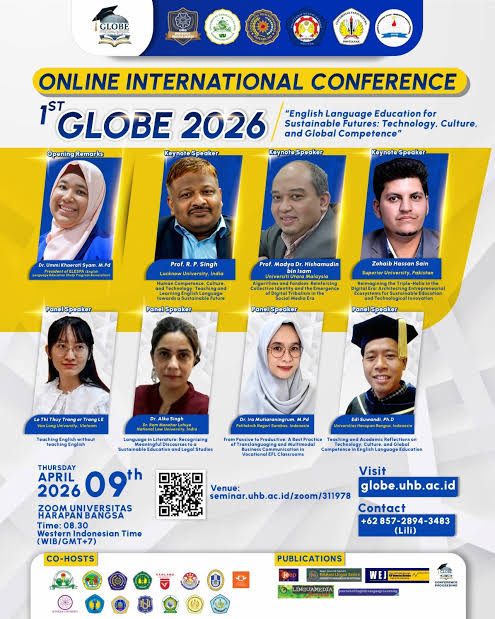
Beyond Assistance: AI as Reflective Learning Partner for Sustainable English Language Learning
Keywords:
artificial intelligence in education, reflective learning, sustainable language learning, EFL, AI integrationAbstract
The rapid growth of artificial intelligence (AI) applications in English language learning has significantly transformed how learners access information, generate texts, and complete academic tasks. While AI tools enhance efficiency and provide valuable language support, their use as direct answer-generating systems may encourage dependency and superficial learning. This paper argues that AI should move beyond simple assistance and be reconceptualized as a reflective learning partner that supports sustainable English language development. Using a conceptual research design grounded in current discussions on AI integration and reflective learning theory, this study explores the pedagogical shift from AI as a convenience tool to AI as a facilitator of metacognitive engagement. The paper proposes a Reflective AI Integration Framework that encourages learners to engage in self-questioning, revision, critical evaluation of AI-generated responses, and iterative improvement during the learning process. By positioning AI as a collaborative thinking partner rather than a substitute for cognitive effort, this study contributes to ongoing discussions on sustainable English language education in the digital era. The proposed framework provides practical guidance for educators and learners seeking to balance technological innovation with long-term language competence and global readiness.
References
Boud, D., Keogh, R., & Walker, D. (1985). Reflection: Turning experience into learning. London: Kogan Page.
Dewey, J. (1933). How we think: A restatement of the relation of reflective thinking to the educative process. Boston: D.C. Heath and Company.
Gilson, L. L., & Goldberg, C. B. (2015). Editors’ comment: So, what is a conceptual paper? Group & Organization Management, 40(2), 127–130.
Godwin-Jones, R. (2021). Emerging technologies: Artificial intelligence and language learning. Language Learning & Technology, 25(3), 5–15.
Holmes, W., Bialik, M., & Fadel, C. (2019). Artificial intelligence in education: Promises and implications for teaching and learning. Boston: Center for Curriculum Redesign.
Luckin, R., Holmes, W., Griffiths, M., & Forcier, L. B. (2016). Intelligence unleashed: An argument for AI in education. London: Pearson Education.
Zawacki-Richter, O., Marín, V. I., Bond, M., & Gouverneur, F. (2019). Systematic review of research on artificial intelligence applications in higher education. International Journal of Educational Technology in Higher Education, 16(39), 1–27.
Zhai, X., Chu, X., Chai, C. S., Jong, M. S. Y., Istenic, A., Spector, J. M., & Li, Y. (2021). A review of artificial intelligence in education from 2010 to 2020. Complexity, 2021, 1–18.
Kukulska-Hulme, A. (2020). Will mobile learning change language learning? ReCALL, 32(2), 123–132.
Chapelle, C. A. (2017). Technology and the future of language teaching. Foreign Language Annals, 50(1), 12–25.
Stockwell, G., & Hubbard, P. (2013). Some emerging principles for mobile-assisted language learning. Monterey, CA: The International Research Foundation for English Language Education.
Warschauer, M., & Grimes, D. (2007). Audience, authorship, and artifact: The emergent semiotics of web 2.0. Annual Review of Applied Linguistics, 27, 1–23.
Reinders, H., & White, C. (2016). Twenty years of autonomy and technology: How far have we come and where to next? Language Learning & Technology, 20(2), 143–154.
Kessler, G. (2018). Technology and the future of language teaching. Foreign Language Annals, 51(1), 205–218.
Li, S., & Lan, Y. (2021). Artificial intelligence in language learning: Current research and future directions. Computer Assisted Language Learning, 34(3), 1–15.
Kasneci, E., Sessler, K., Küchemann, S., Bannert, M., Dementieva, D., Fischer, F., Gasser, U., Groh, G., Günnemann, S., Hüllermeier, E., Krusche, S., Kutyniok, G., Michaeli, T., Nerdel, C., Pfeiffer, F., Poquet, O., Sailer, M., Schmidt, A., Seidel, T., Stadler, M., & Kasneci, G. (2023). ChatGPT for good? On opportunities and challenges of large language models for education. Learning and Individual Differences, 103, 102274.
Tlili, A., Shehata, B., Adarkwah, M. A., Bozkurt, A., Hickey, D. T., Huang, R., & Agyemang, B. (2023). What if the devil is my guardian angel: ChatGPT as a case study of using chatbots in education. Smart Learning Environments, 10(1), 15.