
Open Journal Systems Universitas Harapan Bangsa
Journals
-
KORISA: Jurnal Kolaborasi Riset Sarjana
KORISA: Jurnal Kolaborasi Riset Sarjana adalah publikasi ilmiah terkemuka yang diterbitkan oleh Lembaga Penelitian dan Pengabdian kepada Masyarakat (LPPM) Universitas Harapan Bangsa. Jurnal ini bertujuan untuk menyediakan forum ilmiah berkualitas tinggi untuk penelitian dan pengabdian kajian lintas disiplin di bidang sains, kesehatan, ilmu sosial, hukum, dan pendidikan. Kami menerima dan menerbitkan artikel yang mencakup temuan-teknologi inovatif, metodologi baru, dan analisis mendalam yang memberikan kontribusi signifikan terhadap perkembangan ilmu pengetahuan dan praktik profesional. Jurnal ini dipublikasikan dengan Nomor E-ISSN: 3063-9263
-
Jurnal Pengabdian Masyarakat - PIMAS
Jurnal Pengabdian Masyarakat (PIMAS) merupakan jurnal peer-review open access yang terbit tiga kali dalam setahun. Jurnal pengabmas ini diterbitkan oleh LPPM Universitas Harapan Bangsa (UHB). Jurnal PIMAS bertujuan untuk menyediakan forum nasional dan internasional bagi akademisi, peneliti, dan profesional untuk berbagi ide pengabdian pada bidang seperti Kesehatan, Bisnis, Teknologi, Sosial, Pendidikan, Ekonomi dan semua kegiatan pengabdian masyarakat. Jurnal ini memuat hasil-hasil pengabdian masyarakat berbasis penelitian seperti PAR (Participatory Action Research), ABCD (Asset Based Community Development), CBR (Community-Based Research), Service Learning, Community Development, dan metodologi lainnya.
Journal Manager: Arif Setia Sandi A, S.Kom., M.Kom
Journal Editor: Deni Nugroho Tri Wibowo, S.Kom., M.Kom
-
Jurnal Hukum In Concreto
Jurnal Hukum In Concreto is a blind, peer-reviewed, open-access, online journal of research, reports, book reviews, and commentaries on all aspects of legal science published by the Law Study Programme of the Faculty of Social Sciences, Universitas Harapan Bangsa Purwokerto.
Jurnal Hukum In Concreto aims to provide a place for academics, researchers and practitioners to publish their research articles. The scope of articles published in this journal addresses legal issues and any new developments and advancements in the field of law. -
Viva Medika: Jurnal Kesehatan, Kebidanan dan Keperawatan
Viva Medika is an international journal that publishes original research articles and scholarly works related to health sciences, including nursing, midwifery, health technology, health law, pharmacy, and other interdisciplinary topics within the broader field of health. The journal is published three times a year in March, July, and November, with the mission of disseminating, exchanging, and advancing scientific knowledge through high-quality academic publications.
As an international scholarly platform, Viva Medika serves as a medium of communication for researchers, lecturers, practitioners, and academic communities concerned with health, nursing, and midwifery at both national and global levels. The journal encourages contributions that address current health challenges, promote evidence-based practice, and foster interdisciplinary collaboration across diverse international contexts.
Journal Abbreviation: VIVA MEDIKA
Since: 2018
Issues Per Year: 3 Issues (Publish March, July, and November)
Publication Fee: IDR 500.000
Published Articles: Review Article / Research Article
Review Method: Double-BlindAll article published in Viva Medika are open access and under the CC BY SA license (https://creativecommons.org/licenses/by-sa/4.)
-
Jurnal Ilmu Komputer dan Teknologi
Jurnal Ilmu Komputer dan Teknologi (IKOMTI) is published by LPPM Universitas Harapan Bangsa in February, June, and October. Contributed papers must be original and offer a state-of-the-art contribution. Each paper will be reviewed by at least two independent reviewers in the relevant field. IKOMTI aims to bring together research work in the area of computer science, information systems and information technology. Encourage scientist, practicing engineers, and others to conduct research and other similar activities. The Ministry of Research, Technology/National Research and Innovation Agency of the Republic of Indonesia has accredited IKOMTI with Peringkat 3 (SINTA 3) from 2025 to 2029 with the decree number 295/C/C3/KPT/2026.
Journal Abbreviation: IKOMTI
Since: 2020
Issues Per Year: 3 Issues (Publish February, June, & October)
Publication Fee: IDR 600.000
Published Articles: Review Article / Research Article
Review Method: Double-BlindAll article published in IKOMTI are open access and under the CC BY license (http://creativecommons.org/licenses/by/4.0/)
-
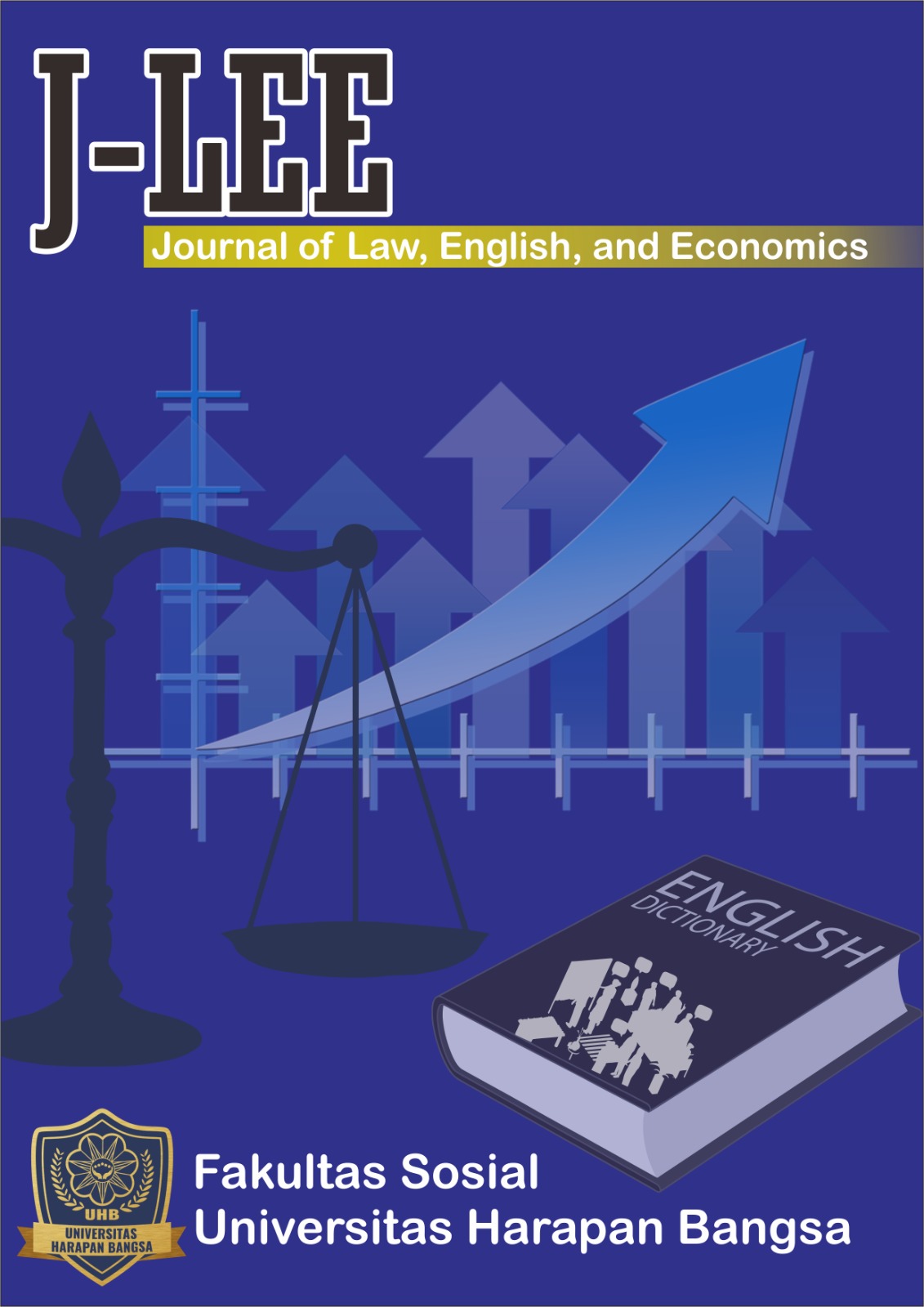
J-LEE - Journal of Law, English, and Economics
Journal Law, English and Economics is published by LPPM Universitas Harapan Bangsa. Published every June and December. Contributed papers must be original and offer a state-of-the-art contribution. Each paper will be reviewed by independent reviewers in the relevant field. JLEE aims to bring together research work in the area of law, english, management and accounting.
-
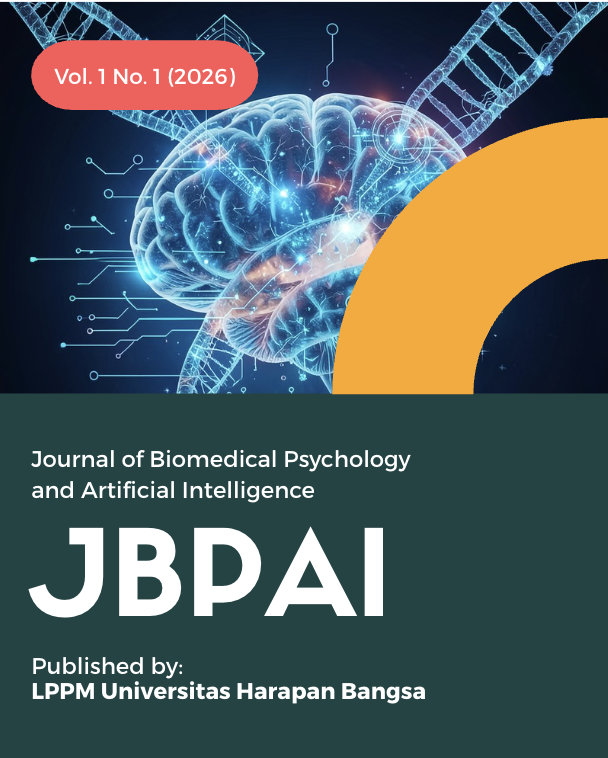
Journal of Biomedical Psychology and Artificial Intelligence
Journal of Biomedical Psychology and Artificial Intelligence (JBPAI) is an international peer-reviewed journal dedicated to advancing interdisciplinary research at the intersection of biomedical science, psychology, and artificial intelligence. The journal provides a scholarly platform for theoretical, methodological, and applied contributions that integrate computational intelligence with psychological and biomedical understanding of human health.
Journal Abbreviation: JBPAI
Since: 2026
Issues Per Year: 3 Issues (Publish February, June, & October)
Publication Fee: 0 USD
Published Articles: Review Article / Research Article
Review Method: Double-BlindAll article published in JBPAI are open access and under the CC BY license (http://creativecommons.org/licenses/by/4.0/)
JBPAI focuses on research that bridges biological systems, cognitive and behavioral science, and intelligent computational models. The journal welcomes studies that explore how artificial intelligence can enhance diagnosis, therapy, rehabilitation, mental health assessment, cognitive modeling, and biomedical decision systems. Emphasis is placed on scientifically grounded AI methods that are informed by psychological theory and biomedical evidence.
The journal promotes rigorous, reproducible, and ethically responsible research. Submissions may include original research articles, methodological papers, clinical AI studies, interdisciplinary reviews, and translational work that connects laboratory findings to real-world healthcare applications. JBPAI encourages collaboration across computer science, psychology, neuroscience, medicine, and biomedical engineering to foster innovations that improve human well-being.
The mission of JBPAI is to support the development of intelligent systems that are psychologically informed, biologically grounded, and clinically meaningful. By integrating biomedical knowledge with psychological insight and artificial intelligence, the journal aims to contribute to the next generation of human-centered healthcare technologies.
-
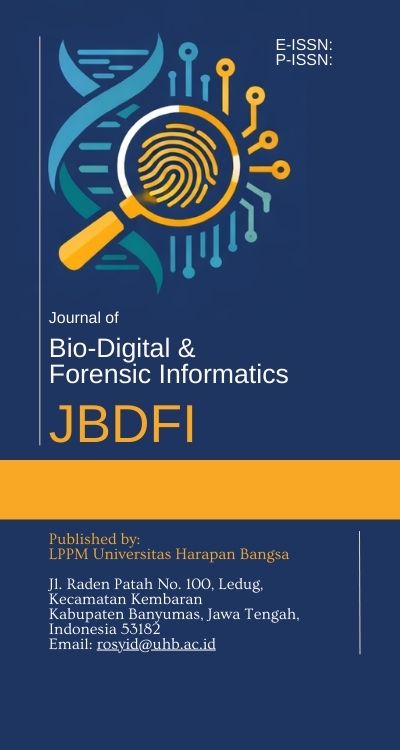
Journal of Bio-Digital and Forensic Informatics
Journal of Bio-Digital and Forensic Informatics (JBDFI) is an international, peer-reviewed open-access journal dedicated to advancing research at the intersection of bioinformatics, digital forensics, artificial intelligence, and evidence-based computational methods. The journal serves as a scholarly platform for studies that integrate biological data, digital artifacts, and intelligent analytical techniques to generate verifiable and reproducible scientific knowledge.
Journal Abbreviation: J.B.D.F.Inf.
Since: 2026
Issues Per Year: 4 Issues (Articles are published online as soon as they are ready for publication)
Publication Fee: 0 USD
Published Articles: Research Article / Review Article / Short Communication (including Case Study)
Review Method: Double-BlindAll article published in JBPAI are open access and under the CC BY license.
Guided by the principle of “A convergence journal for evidence-based computational science,” JBDFI emphasizes methodological rigor, data integrity, and analytical transparency. The journal welcomes research that employs computational models, machine learning, forensic analytics, and data-driven reasoning to address complex scientific, technological, and societal challenges.
JBDFI prioritizes interdisciplinary contributions that bridge traditionally separated domains, including computational biology, digital and cyber forensics, intelligent decision-support systems, and bio-digital evidence analysis. Submissions are expected to demonstrate clear methodological foundations, sound experimental or analytical design, and meaningful contributions to theory, practice, or policy.
By fostering collaboration across scientific and technological disciplines, JBDFI aims to support the development of trustworthy computational science and promote responsible innovation grounded in empirical evidence.
-
Proceedings of the International Conference GLOBE Forum
Conference Sections – Proceedings of the International Conference GLOBE Forum 2026
1. English Education
Technology, Culture, and Global Competence for Sustainable Futures
In today's rapidly evolving global landscape, English Language Education (ELE) stands at the intersection of technology, culture, and sustainability. The emergence of Artificial Intelligence (AI), multimodal learning environments, and digital communication has transformed how English is taught, learned, and used across contexts. At the same time, the need for intercultural understanding and global citizenship has become increasingly important in building more inclusive, equitable, and sustainable societies.
This section invites educators, researchers, and practitioners to discuss innovative approaches in English education, including digital pedagogy, AI-assisted learning, intercultural communication, and global competence development. The goal is to explore how English education can prepare future-ready learners who are linguistically proficient, technologically capable, and culturally aware in a globalized world.
2. Social Humanities
Economics, Management, and Law in Global Contexts
Globalization has significantly transformed economic systems, managerial practices, and legal frameworks across countries. The integration of global markets, rapid technological advancement, and increased mobility of capital, goods, services, and labor have created new challenges and opportunities that require interdisciplinary perspectives.
This section focuses on discussions related to economics, management, and law within global contexts. Scholars and practitioners are invited to share research and insights on global economic dynamics, business innovation, governance, public policy, and legal frameworks that shape sustainable development and responsible global practices.
Proceedings of the International Conference GLOBE Forum 2026 provides a collaborative platform for scholars, professionals, and policymakers to exchange knowledge and innovations across disciplines. The forum aims to connect academic research with real-world challenges and promote sustainable and inclusive global development.
Date: April 9-10, 2026