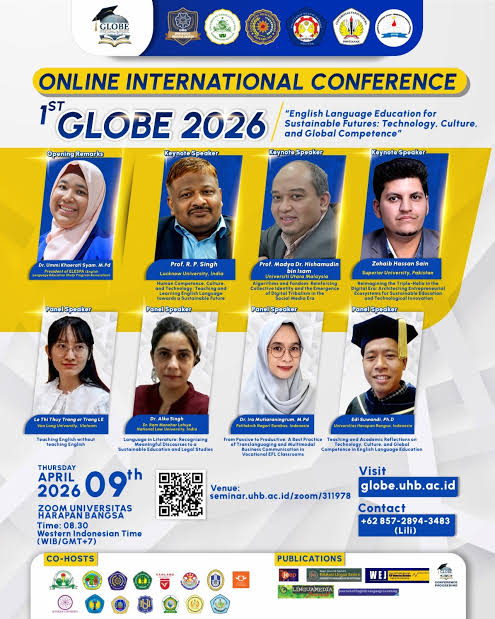
From Passive to Productive: A Best Practice of Translanguaging and Multimodal Business Communication in Vocational EFL Classrooms
Keywords:
translanguaging, digital multimodal composing, vocational college, best practiceAbstract
Although communicative approaches are widely advocated in EFL contexts, their implementation often fails to engage low-proficiency vocational students in a meaningful way. Low English proficiency among vocational college students in Indonesia often results in minimal participation in learning. This article describes best practices for implementing translanguaging and multimodal-based learning to increase student engagement and productivity in English for Specific Purposes (ESP) classes. These practices were applied to students in the Tourism Business Management (D4) programs in a polytechnic environment with relatively low English proficiency levels. The learning was designed in the form of a project to create a business proposal, infographic, and poster, presented using the digital platform Canva as a form of multimodal composition. Next, students discussed the results of their work through Google Classroom, using a translanguaging approach that flexibly incorporated Bahasa Indonesia, English, and Malay to support understanding and interaction. The results of the practice showed an increase in active student participation, courage in expressing ideas, and a better understanding of the learning material. The use of multimodal allows students to express ideas more variedly, while translanguaging acts as a bridge to overcome language barriers. However, challenges such as limited vocabulary and dependence on Bahasa Indonesia were still encountered. Overall, this practice demonstrates that integrating translanguaging and multimodal learning in a vocational context can transform students from passive to more productive English users. This approach is recommended as an inclusive and contextual learning strategy for students with limited English proficiency.
References
Akter, S. N., Madaan, A., Lee, S., Yang, Y., & Nyberg, E. (2024). Self-Imagine: Effective Unimodal Reasoning with Multimodal Models using Self-Imagination.
Bouchey, B., Castek, J., & Thygeson, J. (2021). Multimodal Learning. In Innovative Learning Environments in STEM Higher Education (pp. 35–54). Cham: Springer International Publishing. https://doi.org/10.1007/978-3-030-58948-6_3
Braun, V., & Clarke, V. (2006). Using Thematic Analysis in Psychology. Qualitative Research in Psychology, 3(2), 77–101. https://doi.org/10.1191/1478088706qp063oa
Cenoz, J., & Gorter, D. (2017). Minority languages and sustainable translanguaging: threat or opportunity? Journal of Multilingual and Multicultural Development, 38(10), 901–912. https://doi.org/10.1080/01434632.2017.1284855
Cenoz, J., & Gorter, D. (2020). Teaching English through pedagogical translanguaging. World Englishes, 39(2), 300–311. https://doi.org/10.1111/weng.12462
Cenoz, J., & Gorter, D. (2021). Pedagogical Translanguaging. Cambridge University Press. https://doi.org/10.21153/tesol2023vol31no2art1799
Datu, Y. A., & Sulindra, E. (2025). Are Vocational High School Students Ready for Global Competitiveness?: Self-Perception on Their English Proficiency. Social Science and Humanities Journal, 9(01), 6383–6394. https://doi.org/10.18535/sshj.v9i01.1588
Duarte, J. (2020). Translanguaging in the context of mainstream multilingual education. International Journal of Multilingualism, 17(2), 232–247. https://doi.org/10.1080/14790718.2018.1512607
García, O., & Wei, L. (2015). Translanguaging, bilingualism, and bilingual education. In The handbook of bilingual and multilingual education (pp. 223–240).
Jewitt, C. (2015). Multimodal Analysis. In The Routledge Handbook of Language and Digital Communication (pp. 69–84). Routledge.
Katz, L. G. (1994). The Project approach. https://files.eric.ed.gov/fulltext/ED368509.pdf
Krajcik, J. S., & Shin, N. (2014). Project-Based Learning. In The Cambridge Handbook of the Learning Sciences (pp. 275–297). Cambridge University Press. https://doi.org/10.1017/CBO9781139519526.018
Kress, G. R. . (2010). Multimodality : a social semiotic approach to contemporary communication. Routledge.
MacSwan, J. (2019). A Multilingual Perspective on Translanguaging. In Decolonizing foreign language education (Number 1, pp. 186–219). Routledge.
Mayer, R. E. (2014). IncorporatingMotivation into Multimedia Learning. Learning and Instruction, 29, 171–173. https://doi.org/10.1016/j.learninstruc.2013.04.003
Misbah, Z., Gulikers, J., Dharma, S., & Mulder, M. (2020). Evaluating competence-based vocational education in Indonesia. Journal of Vocational Education & Training, 72(4), 488–515. https://doi.org/10.1080/13636820.2019.1635634
Patton, Alec. (2012). Work That Matters The Teacher’s Guide to Project-based Learning. The Paul Hamlyn Foundation.
Pithers, R., & Lim, R. (1997). A non-english-speaking background in adult vocational education: breaking through the barriers. Journal of Vocational Education and Training, 49(4), 531–544. https://doi.org/10.1080/13636829700200034
Riquelme, F., Munoz, R., Mac Lean, R., Villarroel, R., Barcelos, T. S., & de Albuquerque, V. H. C. (2019). Using multimodal learning analytics to study collaboration on discussion groups. Universal Access in the Information Society, 18(3), 633–643. https://doi.org/10.1007/s10209-019-00683-w
Safont, P. (2022). ‘In English!’ teachers’ requests as reactions to learners’ translanguaging discourse. Language, Culture and Curriculum, 35(3), 317–333. https://doi.org/10.1080/07908318.2021.1979578
Spikol, D., Ruffaldi, E., & Cukurova, M. (2017, September). Using Multimodal Learning Analytics to Identify Aspects of Collaboration in Project-Based Learning. CSCL’17: The 12th International Conference on Computer Supported Collaborative Learning. https://doi.org/10.22318/cscl2017.37
Talebi, K. (2015). John Dewey–Philosopher and Educational Reformer. Http://Dx.Doi.Org/10.6084/M9.Figshare.2009706, 1(1). https://doi.org/http://dx.doi.org/10.6084/m9.figshare.2009706
Tsortanidou, X., Daradoumis, T., & Barberá-Gregori, E. (2022). Convergence among imagination, social-emotional learning and media literacy: an integrative literature review. Early Child Development and Care, 192(2), 173–186. https://doi.org/10.1080/03004430.2020.1753720
Van Leeuwen, T. (2020). Multimodality and multimodal research. In The SAGE Handbook of Visual Research Methods (2nd ed., pp. 465–483). SAGE.
Wawire, B. A., & Barnes-Story, A. (2023). Translanguaging for multiliteracy development: pedagogical approaches for classroom practitioners. International Journal of Bilingual Education and Bilingualism, 26(2), 173–188. https://doi.org/10.1080/13670050.2022.2094702
Wei, L. (2018). Translanguaging as a Practical Theory of Language. Applied Linguistics, 39(1), 9–30. https://doi.org/10.1093/applin/amx039
Wei, L., & Lin, A. M. Y. (2019). Translanguaging classroom discourse: pushing limits, breaking boundaries. Classroom Discourse, 10(3–4), 209–215. https://doi.org/10.1080/19463014.2019.1635032
Yan, L., Echeverria, V., Jin, Y., Fernandez‐Nieto, G., Zhao, L., Li, X., Alfredo, R., Swiecki, Z., Gašević, D., & Martinez‐Maldonado, R. (2024). Evidence‐based multimodal learning analytics for feedback and reflection in collaborative learning. British Journal of Educational Technology, 55(5), 1900–1925. https://doi.org/10.1111/bjet.13498
Yan, L., Wu, X., & Wang, Y. (2025). Student engagement assessment using multimodal deep learning. PLOS One, 20(6), e0325377. https://doi.org/10.1371/journal.pone.0325377
Yildirim, K. N., & Bal, N. G. (2023). English Language Education in a Vocational School: A Qualitative Case Study. Participatory Educational Research, 10(2), 275–297. https://doi.org/10.17275/per.23.40.10.2